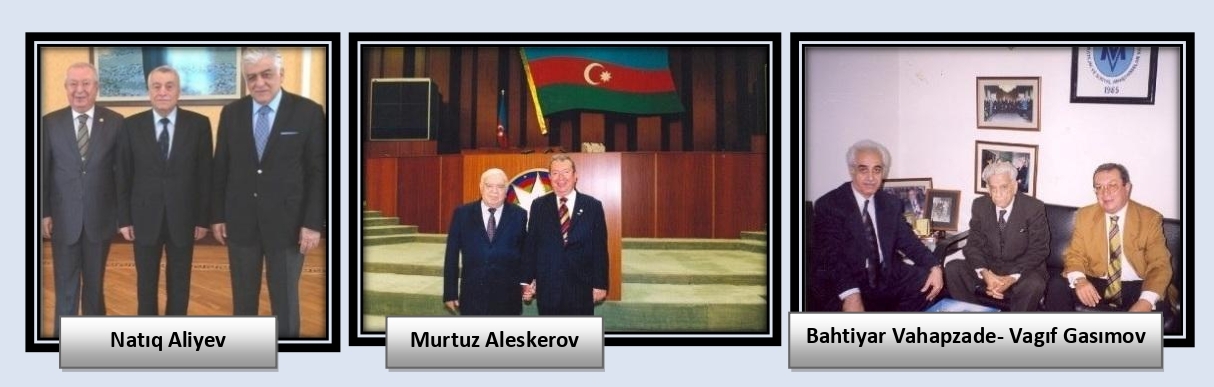
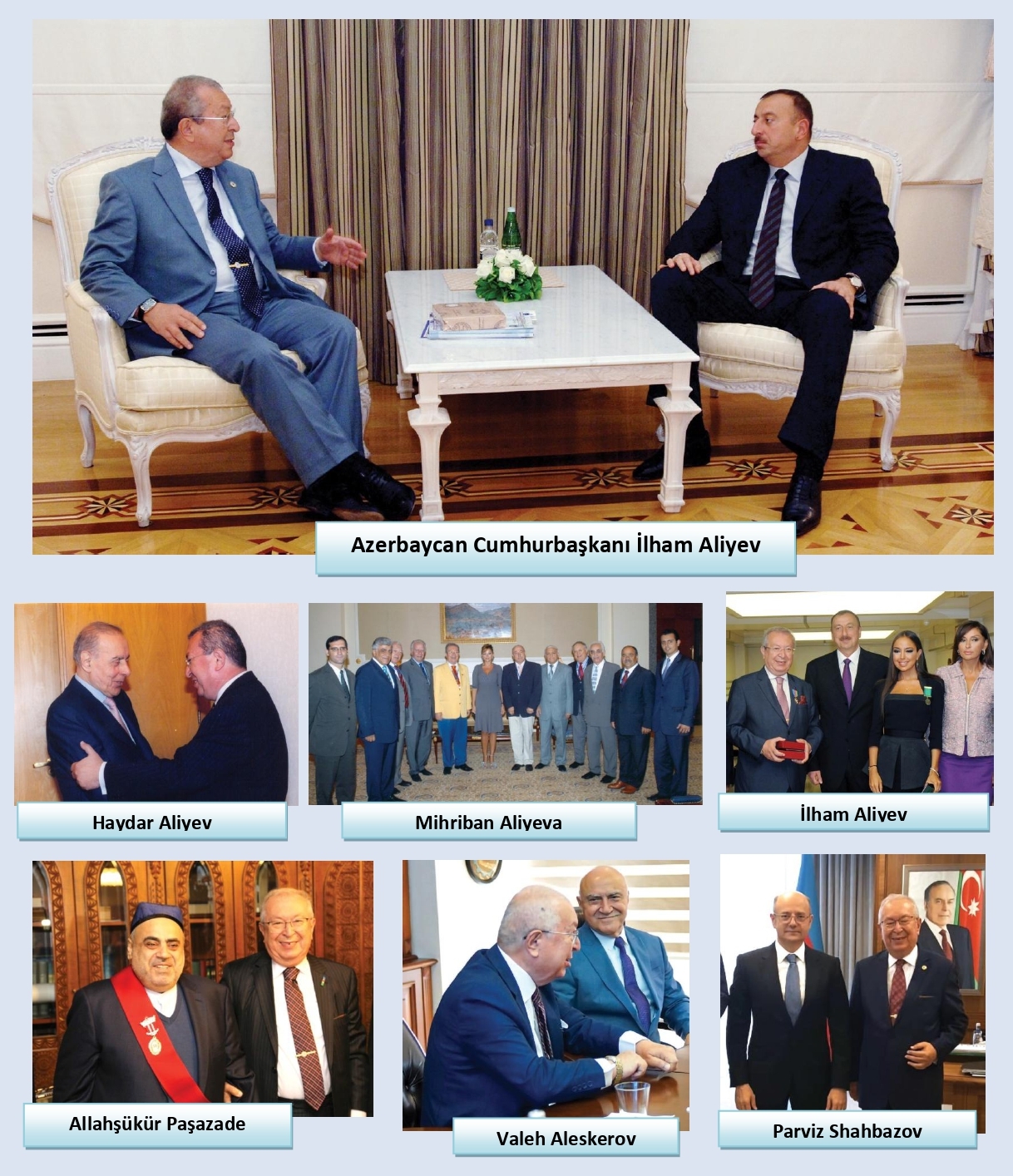
The State of Azerbaijan has always been generous to the Marmara Group Foundation. The Azerbaijani State, which awarded Dr. Akkan Suver an honorary doctorate, also bestowed upon him the "Terakki Medal" and the "Dostluq Order." The Azerbaijani State, which awarded both the Terakki Medal and the "Dostluq Order" to Marmara Group Foundation Board Member Şamil Ayrım, also facilitated the publication of three separate books by Dr. Akkan Suver in the Azerbaijani language. The Azerbaijan Ministry of Transport also made a gesture to the Marmara Group Foundation by issuing a special stamp at the 18th Eurasian Economic Summit.
The Marmara Group Foundation holds a special place in the civil society dimension of the Turkey-Azerbaijan relations, where excellent cooperation has been successfully realized in every field. This cooperation stems from our deep-rooted fraternal relations. As the Marmara Group Foundation, we strive to maintain these relations at the level they deserve.
Meanwhile, the progress Azerbaijan has made on the international stage is commendable.
Azerbaijan, a respected member of the international community, is regarded as a favored investment destination in business and economic circles due to its rich natural resources and economic potential.
In our youth, Paris was referred to as the "ville de lumière - city of light." I believe that in time, foreigners will attribute this title to Baku, the capital of Azerbaijan. Once known as the city of winds in the land of fires, Baku is now a city of lights.
The efforts devoted to the city's development over the years have brought us face to face with an atmosphere indistinguishable from any European city today. When the beautifully restored houses, faithful to the past, and the artistic structures, each bearing unique architectural examples and meanings, are added to this pleasant atmosphere, a true city of lights emerges.
Meanwhile, stores equipped with some of the world's leading brands add vibrancy to Baku's daily life, rivaling Paris, London, and Milan. The immortal work of the late world-renowned architect Zaha Hadid, inspired by the waves of the Caspian Sea, the Heydar Aliyev Center, along with the flame towers—some of the finest examples of modern architecture—stadiums that inject youth into the city, and Formula 1 races have made Baku a city embracing the unreachable.
Nowadays, we also witness the renovation of the city's suburbs. The poorly constructed houses from the communist era, removed through large expropriations, are being replaced by new living spaces, wide boulevards, and green areas. As much as Baku is a city of lights, it is now equally a city of greenery. Its wide parks, seaside promenades, and squares adorned with large trees and fountains allow the breath of the Caspian to be felt deep within Baku, marking the new identity given to this city.
We also call Azerbaijan "Can Azerbaijan" (Dear Azerbaijan). This has a historical root.
In the early days of the War of Independence, Mustafa Kemal Pasha wrote a letter to Kazım Karabekir Pasha, commander of the Eastern Front, stating, "The state has no money. Also, there are no internal resources. I suggest borrowing money from the Azerbaijani government until new resources are reached." Karabekir Pasha conveyed this to the Azerbaijani government. This was the first official contact between Ankara and the Azerbaijan Soviet Socialist Republic. Neriman Nerimanov first sent 500 kilograms of gold to Turkey, then 10 million gold rubles from Russia to Ankara. Later, Mustafa Kemal Pasha sent a letter saying, "We will repay as soon as the war ends." Upon receiving this, Neriman Nerimanov wrote back to Ankara, saying, "Dear Pasha, we Turks do not lend money to brothers. Brothers always help each other. We are brothers and will continue to hold your hand."
That is why we call Azerbaijan "Can Azerbaijan." Now we have an important duty. We believe that the SOCAR project should not be called a foreign investment. It would be more logical to call it the largest project our brother has invested in our country. We once again remember Heydar Aliyev saying, "I unite one nation, two states," and "I unite Azerbaijan and Turkey with thick chains on the Baku-Tbilisi-Ceyhan pipeline."
For many years, the greatest problem faced by our brother Azerbaijan, both regionally and internationally, was undoubtedly the occupation of Nagorno-Karabakh.
The Azerbaijani lands, occupied for many years by the Armenian State, were not returned to Azerbaijan despite numerous international resolutions and warnings due to Armenia's lawlessness. Moreover, Armenia repeatedly violated borders at will and dared to shoot bullets and throw bombs at civilian settlements in Azerbaijani territory.
Armenia, which stubbornly refused to accept the rights granted to Azerbaijan at the negotiation table, further escalated its audacity in the summer of 2020 by resorting to bomb attacks targeting civilians.
The Azerbaijani State, which showed patience until the last moment, finally gave the necessary response to the occupying Armenia through its Armed Forces and brought Armenia to its knees.
This subjugation was carried out within justice. Since Azerbaijan first granted Armenia a period to withdraw from the occupied lands upon permission and then upon request, it also demonstrated the nobility of adhering to fairness and reason.
During these events, Turkey stood fully by Azerbaijan. To put it figuratively, Turkey rose and slept with Azerbaijan.
As the Marmara Group Foundation, we have stood by Can Azerbaijan, its glorious army, President Ilham Aliyev—who has demonstrated exemplary diplomacy and statesmanship from day one—and our Azerbaijani brothers who have maintained unity like a fist from past to present, in our capacity as a civil society organization, and we continue to do so.