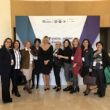
The “Equality, Justice and Women’s Summit,” organized by civil society organizations focused on women’s struggle for equality and justice, and with Müjgan Suver, President of the Marmara Group Foundation EU and Human Rights Platform, serving on the Organizing Committee, was held on November 30 - December 1, 2017 at the WOW Hotel in Istanbul. The meeting was attended by nearly 1,500 participants including journalists, politicians, academics, and women activists. The Summit opened with the song "Women Exist" and featured 8 panels and 5 workshops. The panels included 27 speakers, well known to society, alongside moderators. At the "Equality, Justice and Women’s Summit," where knowledge and experiences were shared and problems and solutions discussed, the final declaration shared with the public emphasized once again that there can be no justice without equality, and therefore the issue of gender equality is fundamentally a democracy issue. At the conclusion of the workshops, a "roadmap for women" was determined by active citizens:
Equality, Justice, Women’s Summit 2017
Final Declaration
We Demand Equality for Justice.
Expectations from Political Will;
Citizens of different genders, languages, religions, sexual orientations, and political views must have equal opportunities.
International conventions ensuring gender equality, which Turkey has signed and is obliged to implement, must be enforced, and in cases of violations, recourse should be made to the ombudsman.
Hostile hate speech that creates pressure and violence against women must be prevented. A common language prioritizing inclusive, ego-free, and non-othering peace language should be established.
The state of emergency (OHAL), which fuels violence, prevents organization, and abolishes democracy, must be lifted immediately.
Pressure must be exerted on law enforcers to ensure the effective implementation of Law No. 6284 on the Protection of the Family and Prevention of Violence Against Women.
State-supported family policies must be abandoned. A Ministry of Women prioritizing gender equality must be established.
Policies and practices aimed at preventing, deterring, and punishing all forms of gender-based violence against women must be targeted for elimination.
Coordination centers, NGO advisory boards, and relevant NGO units should be established in local governments to increase dialogue with civil society.
The NGO Coordination Unit should be added to the Ministry of Interior’s normative staffing regulation, with a working directive written, budget allocated, and quotas established for women’s and LGBTI associations.
Gender equality must be included in the national education curriculum, and unacceptable expressions such as "Obedience to the man is worship" must be urgently removed from the curriculum.
Public officials who have contact with women, children, and LGBTI individuals must be regularly trained on gender, violence against women, and LGBTI rights.
An economic model based on gender equality must be adopted; care services, the biggest barrier to women’s participation in the workforce, must be provided by local and central governments, and the care economy supported.
Special budgets must be allocated at local and central government levels to ensure gender equality; gender-sensitive budgeting must be implemented, and gender-based budget statistics compiled.
The risks of self-declared population registration must be prevented.
Expectations from the Judiciary;
The judiciary must serve a function that eliminates inequality rather than reinforcing patriarchy that humiliates and suppresses women.
An effective monitoring mechanism must be established before the Council of Judges and Prosecutors, especially in areas where gender-biased decisions are made, primarily in criminal proceedings. Gender equality-based courses and practices must be added to the curriculum of the Turkish Justice Academy for the professional training of judges and prosecutors.
Increasing the proportion of women judges and prosecutors in the judiciary must be a fundamental policy priority. Women’s representation should be increased through accelerating tools such as equal distribution (parity), quotas, and numerical targets increasing over the years. These tools should also ensure greater representation of women in high courts, senior positions in the Ministry of Justice, and as prosecutors.
Expectations from Political Parties and Party Leaders;
Full equality – parity understanding to increase women’s presence in decision-making mechanisms must be legally guaranteed in political parties and decision-making bodies and widely implemented in practice.
Instead of a leadership approach that advises women to work harder to enter politics, policies that open more space and empower women should be developed.
The number and effectiveness of women’s councils at every level should be increased to strengthen women’s organization locally.
Müftülük (religious official) marriages should be taken to the Constitutional Court by opposition parties.
A new political model adopting a different perspective and political language for the younger generation should be created.
The knowledge, experience, solution proposals, and capacity accumulated by independent women’s organizations over 30 years should be utilized.
Expectations from Civil Society;
Inclusive and collective organizational structures that include horizontal organization, are knowledge-focused, support solidarity, and emphasize individual rights should be established, and cross-party umbrella organizations formed.
A large gender equality campaign should be launched using all platforms including written, visual, and digital media, in partnership with political parties, the private sector, and civil society.
Women’s organizations and activists should come together to develop problem-based organizational models.
Civil society should rejuvenate by developing technology-based organizational models and digital platforms with innovative methods.
The Equality, Justice and Women’s Summit should convene annually and function effectively toward achieving gender equality.