

Cafer Okray in Sofia
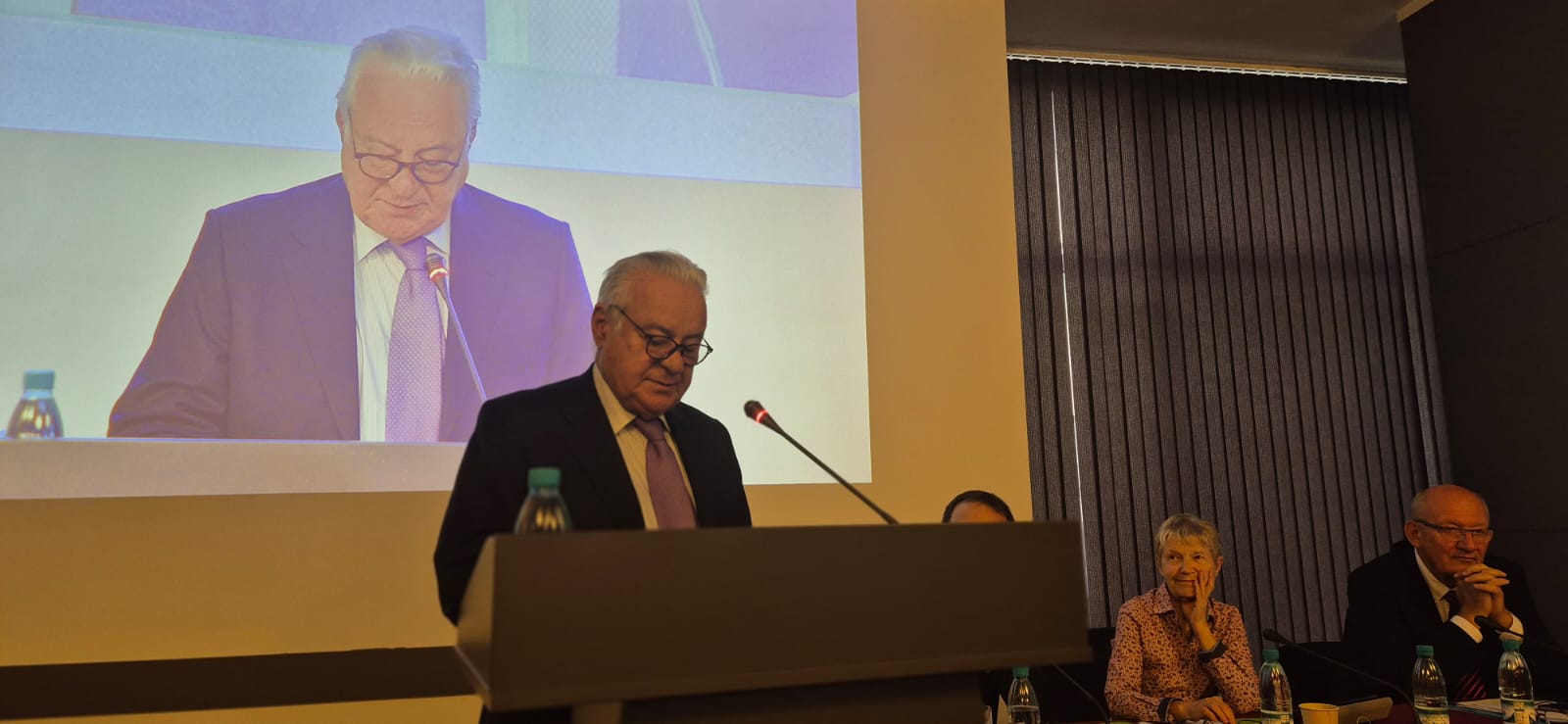
Marmara Group Foundation’s Vice President, Cafer Okray, participated as a speaker in the workshop titled “80 Years After the Yalta and Potsdam Conferences”, organized by the Slavyani Foundation of Bulgaria.
You can find below the presentation delivered by Cafer Okray at the workshop held at the Moscow Park Hotel in Sofia.
Slavyani Foundation
Remarks by Cafer S. Okray
First of all, on behalf of myself and the Marmara Group Foundation, I would like to express our thanks to the Slavyani Foundation and its President, Mr. Zahari Zahariev, for inviting us to such a distinguished event.
We are gathered here to commemorate, or more appropriately, to celebrate, the contributions the Yalta and Potsdam Conferences have provided us all in the past 80 years for international peace and prosperity. We as the Marmara Group Foundation have always supported the notion that in order to honor the memory of our past achievements, we must pursue ways to build on those accomplishments in face of todays challenges. One of those avenues, which encompasses all countries represented here, is the Belt and Road Initiative.
In my speech to you, I will be talking about the benefits that the Belt and Road Initiative (BRI) will provide today to the Balkan geography and the Black Sea region through projects that offer stability and sustainability – conditions which matter today as much as they did 80 years ago.
I would like to begin with a statement made by former Bulgarian Minister of Foreign Affairs, Ekaterina Zaharieva, seven years ago during a meeting with Chinese Foreign Minister Wang Yi: 'The annual '16+1' summits between China and Central and Eastern European countries are beneficial for the European Union as a whole.'
Yes, when speaking about the Belt and Road Initiative, I believe it necessary for EU member states to overcome their reservations.
When we consider the Belt and Road Initiative as a project of peace, stability, and co-development, I see this initiative as an important future economic anchor for the Balkans, which has limited economic resources and capital.
The Belt and Road Initiative is the most comprehensive and largest international initiative for stability, peace, and co-existence created to date. Today, the world is governed by the powers that dominate trade routes. The Belt and Road Initiative, which is developing to safeguard international trade as the driving force behind development and to guarantee target markets, is a movement that will shape the next century.
The Balkans, alongside Türkiye, are geographically located right at the center of this extensive project developed by China. They form the main body of the land route and the middle corridor railway line, offering the biggest alternative to the sea route for transporting goods to the main target market, Europe. The gate opening from Türkiye to Europe starts with the Balkans.
The Belt and Road Initiative, which will ensure the development of relations with the Balkans—an area of competition for great powers—is striving to develop services by basing its strategy on the framework of economic cooperation organizations rather than political superiority. The 16+1 formation is another example of this.
To emphasize in bold strokes, the People's Republic of China is present in the Balkans today through the Belt and Road Initiative. Approximately two hundred economic projects in the Balkans have been or are being implemented within this scope, including various investments and joint projects. These are the economic aspects of the matter. In our view, there is an even more important side to it.
As the Marmara Group Foundation, for thirteen years, we have carefully and meticulously valued the service of these partnerships to peace and
stability. Of course, there will be trade, and of course, it will be 'win-win.' But the stability and peace shaped by dialogue, wealth, and prosperity—secured by mutual gain—are much more important than trade.
Nations that get the chance to live closely together through the Belt and Road Initiative will reach out to each other’s languages, faiths, and cultures, and thus gain the opportunity to know each other.
Segments of society that are very different in terms of cultures, religions, histories, languages, and customs, and at times even opposed to one another, will achieve a social integration. This will create sustainability in the name of stability and peace.
In concluding my remarks, I would like to state that, just as it was in post-war Yalta and Potsdam conferences 80 years ago, the most important need once again is stability. It is lasting peace. We believe that the Belt and Road Initiative will be the key to the door of peace and stability.
Taking this opportunity, we extend our thanks for allowing us, the Marmara Group Foundation, to be with you all here today.
Thank you.
.jpg)